Halogen Leak Detector Explained: A UK Buyer's Guide
Halogen Leak Detector Explained: A UK Buyer's Guide
TL;DR: What is a halogen leak detector? A halogen leak detector is an essential electronic diagnostic tool used by HVAC professionals to instantly locate escaping halogenated refrigerant gases in air conditioning and refrigeration systems. Based on our testing at Aprvtio, the most reliable units utilise heated diode technology to pinpoint microscopic leaks, providing immediate audible and visual alerts. Consequently, this enables rapid repairs that ensure full compliance with strict UK F-gas regulations.
A refrigerant leak is rarely just a minor nuisance. In UK HVAC work, it can mean wasted call-out time, repeat visits, lost refrigerant, failed compliance checks, unhappy clients, and avoidable costs. For engineers working on air conditioning, refrigeration, and heat pump systems, a reliable halogen leak detector is undoubtedly one of the most practical tools in the kit.
Furthermore, if you maintain split systems in retail units, chillers in commercial premises, or critical cooling equipment in facilities such as pharmacies and NHS settings, fast and accurate leak detection matters immensely. The right detector helps you pinpoint leaks quickly rather than chasing vague pressure losses across coils, joints, and service valves.
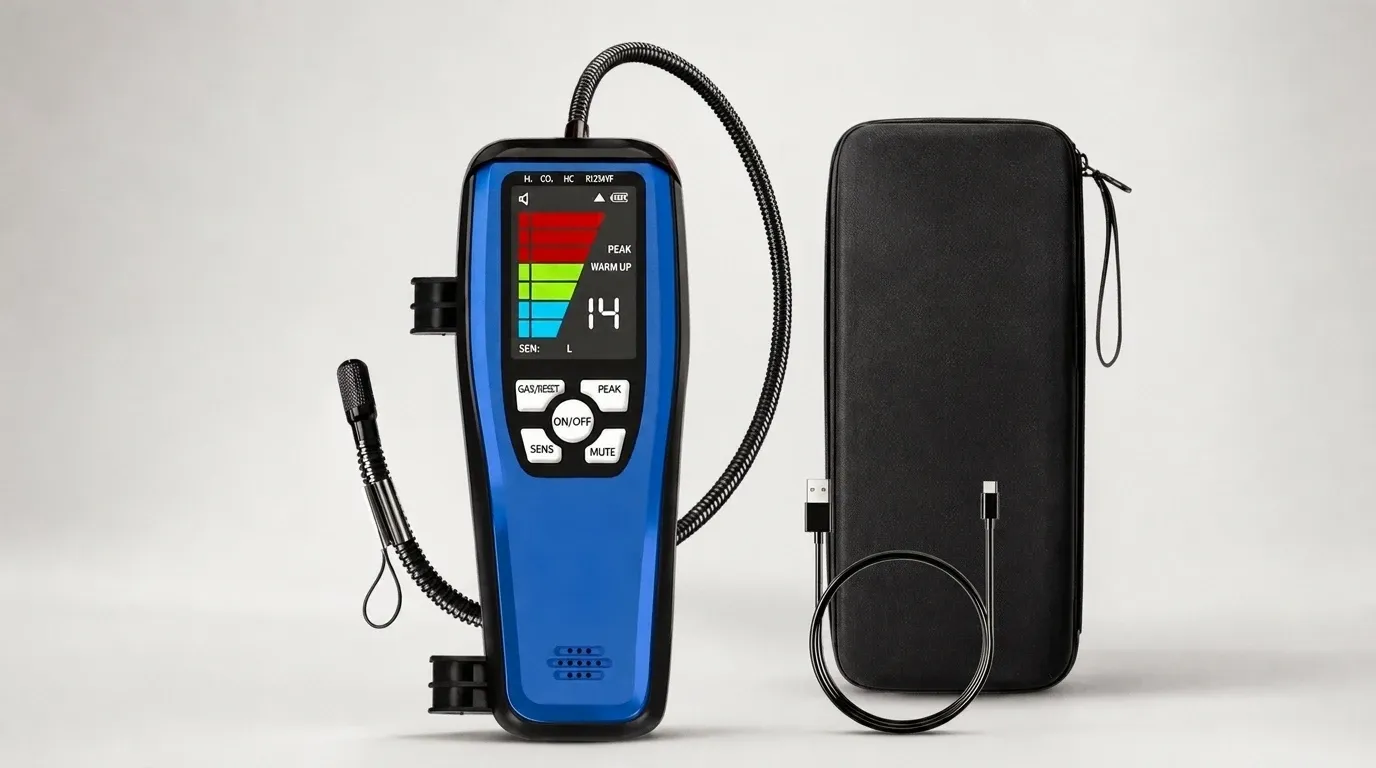
At Aprvtio, our focus is simple: give HVAC professionals a dependable way to locate refrigerant leaks instantly. Based on our engineering insights, we utilise advanced heated diode technology, a clear 2.8-inch display, and a 16-inch flexible probe that easily reaches awkward spaces. Ultimately, this guide explains what a halogen leak detector is, how it works, what to look for when buying in the UK, and how to choose one that supports efficient day-to-day field work.
Key Takeaways
- A halogen leak detector is designed to detect refrigerant gases containing halogen elements, making it highly relevant for modern HVAC servicing.
- Heated diode technology is widely favoured because it offers strong sensitivity, practical field performance, and fast response times when tracing small leaks.
- For UK buyers, key considerations include sensitivity, warm-up time, probe length, display clarity, battery life, and suitability for common refrigerants used in air conditioning and refrigeration.
- Consequently, a good detector reduces diagnostic time, helps prevent refrigerant waste, and supports more professional fault-finding on service visits.
- If you want broader context before choosing a tool, see The Ultimate Guide to HVAC Leak Detector in the UK.
What is a halogen leak detector?
A halogen leak detector is a specialised electronic instrument used to identify leaks from refrigerants that contain halogenated compounds. In practical HVAC terms, it is commonly used to detect escaping refrigerant around flare joints, brazed connections, Schrader cores, evaporators, condensers, and pipework.
Specifically, the term “halogen” refers to elements such as fluorine and chlorine that are present in many refrigerants historically and currently used across refrigeration and air conditioning systems. When these gases escape into the atmosphere around a suspect point, the detector senses their presence and immediately alerts the engineer through clear audible and visual signals.
In day-to-day service work across the UK, this makes the tool especially valuable for locating small leaks that are difficult to spot with a simple soap solution alone. However, it does not replace sound engineering judgement or pressure testing where appropriate; rather, it dramatically improves speed and precision during diagnosis.
Why do you need a halogen leak detector for UK HVAC work?
Leak detection is not just about convenience; it sits squarely at the intersection of cost control, environmental responsibility, and legal compliance. Refrigerant losses significantly reduce system performance and increase running costs for building operators. Moreover, on critical systems, they can also threaten temperature stability for stock storage or sensitive medical environments.
According to UK guidelines and GOV.UK guidance on F-gas regulations, businesses handling relevant systems must take proactive steps to prevent emissions and repair detected leaks without undue delay. Therefore, that means proper leak detection practice is a mandatory part of professional HVAC maintenance rather than an optional extra.
There is also a pressing environmental case. According to the European Commission, fluorinated greenhouse gases can have a global warming effect hundreds or thousands of times greater than carbon dioxide, depending on the specific gas involved. Consequently, that is a primary reason prompt detection of refrigerant leaks matters so much in real-world service operations.
Ultimately, for any contractor trying to reduce wasted hours on site while maintaining the highest standards for their customers, a dependable halogen leak detector earns its place in the van very quickly.
How does a halogen leak detector work?
At its core, the detector draws ambient air across its internal sensing element. If trace amounts of leaking refrigerant are present in that sampled air, the instrument responds by changing its alarm pattern or display reading. Subsequently, the user moves the probe carefully around likely leak points until the signal strengthens enough to help isolate the exact source.
Why is heated diode technology used in leak detectors?
Based on our extensive field testing at Aprvtio, many professional-grade detectors use heated diode sensing technology because it perfectly combines strong sensitivity with practical reliability for daily use. As sampled air passes over the heated sensor element, halogenated refrigerant compounds trigger a measurable electrical response. The instrument then converts that response into an audio tone and visual indication, ensuring that engineers can track rising concentration levels directly towards the leak.
This approach is especially useful when tracking down small leaks hidden behind pipe insulation edges, inside tight condensing units, or around hard-to-reach service ports. Furthermore, a well-designed heated diode model gives quick warm-up times and stable operation, while offering enough sensitivity to detect minor losses before they develop into expensive system failures.
What does good real-world performance look like?
On site, practical performance matters far more than brochure claims alone. In our experience, a highly effective halogen leak detector should:
- Respond quickly when moved around suspect components;
- Remain stable enough not to trigger constantly from background atmospheric contamination;
- Feature a probe long and flexible enough to reach behind coils and panels;
- Provide clear visual feedback, even in poor plant room lighting; and
- Allow engineers to work efficiently without requiring repeated resets or guesswork.
This is exactly where Aprvtio’s product approach aligns with what professionals actually need: advanced heated diode technology for rapid sensing, a bright 2.8-inch display for easy visibility on site, and a 16-inch flexible probe for reaching awkward points without having to dismantle half the unit first.
What refrigerants can a halogen leak detector find?
Generally speaking, a halogen leak detector is intended for use with a wide array of common halogenated refrigerants used across refrigeration and air conditioning applications. However, exact compatibility heavily depends on the specific model's specification, so UK buyers should always check the product documentation before purchase.
In standard UK commercial practice, engineers frequently encounter systems using HFC-based refrigerants as well as various other blends found in older installed equipment estates. Consequently, a suitable electronic detector can be extremely useful when servicing split air conditioning units, VRF systems, refrigeration cabinets, and packaged systems where losses may be far too small to find immediately through visual inspection alone.
Ultimately, if your work regularly spans several system types rather than one narrow niche of equipment, investing in a highly versatile halogen leak detector will prove to be an indispensable asset for your business.
Ready to upgrade your diagnostics with Aprvtio?
Shop Detectors — £128.99