The Ultimate Guide to HVAC Leak Detector in the UK
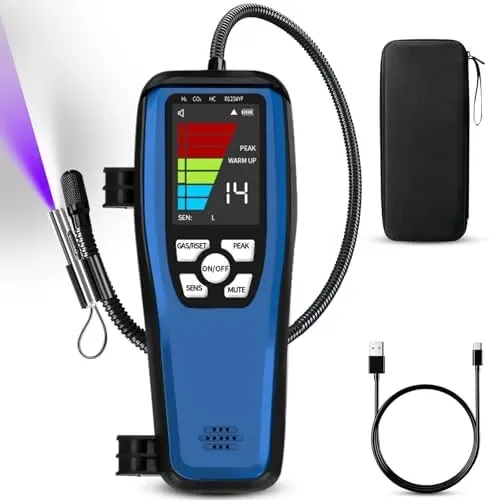
Short answer: an HVAC leak detector is an electronic tool that finds escaping refrigerant on air conditioning, heat pump and refrigeration systems. If you are buying your first one, the priorities are simple: a sensor type that suits modern refrigerants, a clear way to see what it finds, and a method you can follow confidently in front of a customer.
When you have just qualified and can no longer borrow the college's detector, the jargon (heated diode, infrared, sensitivity, warm-up, sensor life) is a lot to take in, and your first tool list already includes a manifold gauge set and a vacuum pump, so the budget is tight. This guide explains how a detector works, how to use one properly, and what to look for in your first purchase.
How does an HVAC leak detector work?
An electronic detector uses a pump to draw air across a sensor. When refrigerant is present, the sensor reacts and the tool alarms with a beep, an LED and, on better units, a reading on a screen. The most common sensor for general HVAC work is the heated diode: sampled air is heated over a ceramic element to a high temperature, which breaks up the halogenated refrigerant molecules and changes the electrical current, triggering the alarm. It is sensitive and not prone to false alarms. Other types include infrared (long sensor life, higher cost) and corona discharge; our halogen leak detector guide compares them all.
How to use an HVAC leak detector correctly
Good technique is what separates a confident diagnosis from a guess. The recommended method is straightforward.
- Switch on in clean air and let it warm up (around 30 seconds) so it calibrates its baseline.
- Choose a sensitivity level: higher to find the general area, lower to pinpoint.
- Scan slowly at about 1 to 2 inches per second, keeping the probe close to and just below each joint, since most refrigerants are heavier than air.
- Confirm and repair: verify the exact point with bubble solution, then follow the full recovery and repair process.
For the same method applied to a real heat pump call, see our refrigerant gas sniffer guide.
Which refrigerants does it need to cover?
In the UK you will meet R32 and R454B on newer AC and heat pumps, R410A on older systems, and R134a on automotive and some commercial work. Check the detector's gas list covers what you service. R32 and R454B are A2L (mildly flammable), so a spark-free heated diode is a sensible first detector. For the AC-specific buying view, our air conditioning leak detector guide goes further.
Sensor life, standards and what a detector cannot do
Two things trip up new engineers. First, heated diode sensors are consumables: a tip has a limited active life (Aprvtio states roughly 100 to 200 hours for the ALD-200), so keep a spare and check the tool against a reference leak. The UK standard BS EN 14624:2020 sets a minimum sensitivity of 5 grams per year, and F-Gas guidance says electronic detectors should be checked every 12 months. Second, a detector locates a leak; it does not replace the F-Gas procedure. Being "compatible with R32" does not mean you can skip recovery, repair, evacuation and documentation.
Choosing your first HVAC leak detector
On a tight budget, look for one tool that covers the common refrigerants, is spark-free for A2L safety, and shows a reading rather than only beeping, so you are never standing in front of a customer able only to hear a click. A rechargeable battery and a built-in light save money and hassle over disposable cells and a separate torch.
The Aprvtio ALD-200 for everyday HVAC leak detection
For a first detector that grows with you, the Aprvtio ALD-200 covers the essentials. It uses spark-free heated diode sensing suitable for A2L gases, supports R32, R454B, R410A and R134a, and shows a reading on a 2.8-inch display instead of only beeping. A 16-inch flexible probe reaches awkward joints, integrated UV and LED lights mean you are not carrying a separate torch, and a 3000 mAh rechargeable battery runs up to around 10 hours. Aprvtio publishes the heated diode tip life as roughly 100 to 200 hours and sells replacement sensors, so you can plan ahead. It is £128.99 inc. VAT (£107.49 ex. VAT), rated 4.7 out of 5 from 285 reviews, and ships from UK stock with a 12-month UK warranty and 30-day returns.
Start out with a detector that shows you what it finds
View the Aprvtio ALD-200 — £128.99Frequently asked questions
What does an HVAC leak detector do?
It finds escaping refrigerant on air conditioning, heat pump and refrigeration systems. An internal pump draws air across a sensor, and when refrigerant is present the tool alarms with a beep, a light and, on better units, a concentration reading, so you can locate a leak before recovering and repairing.
How do you use an HVAC leak detector step by step?
Switch it on in clean air and let it warm up for about 30 seconds, select a sensitivity level, then scan slowly at roughly 1 to 2 inches per second with the probe close to and just under each joint. Confirm the exact point with bubble solution and then follow the full recovery and repair process.
What is the best HVAC leak detector for a trainee on a budget?
Look for one affordable tool that covers the common refrigerants (R32, R454B, R410A and R134a), uses spark-free heated diode sensing for A2L safety, and shows a reading rather than only beeping. A rechargeable battery and built-in light avoid the ongoing cost of disposable cells and a separate torch.
Does an HVAC leak detector replace F-Gas leak checking procedures?
No. A detector locates a leak, but you still follow the full F-Gas process of recovery, repair, evacuation, recharge and record-keeping. Being compatible with R32 does not let you skip any of those steps, and electronic detectors should themselves be checked every 12 months.
Ready to upgrade your diagnostics with Aprvtio?
Shop Detectors — £128.99