Air Conditioning Leak Detector Explained: A UK Buyer's Guide
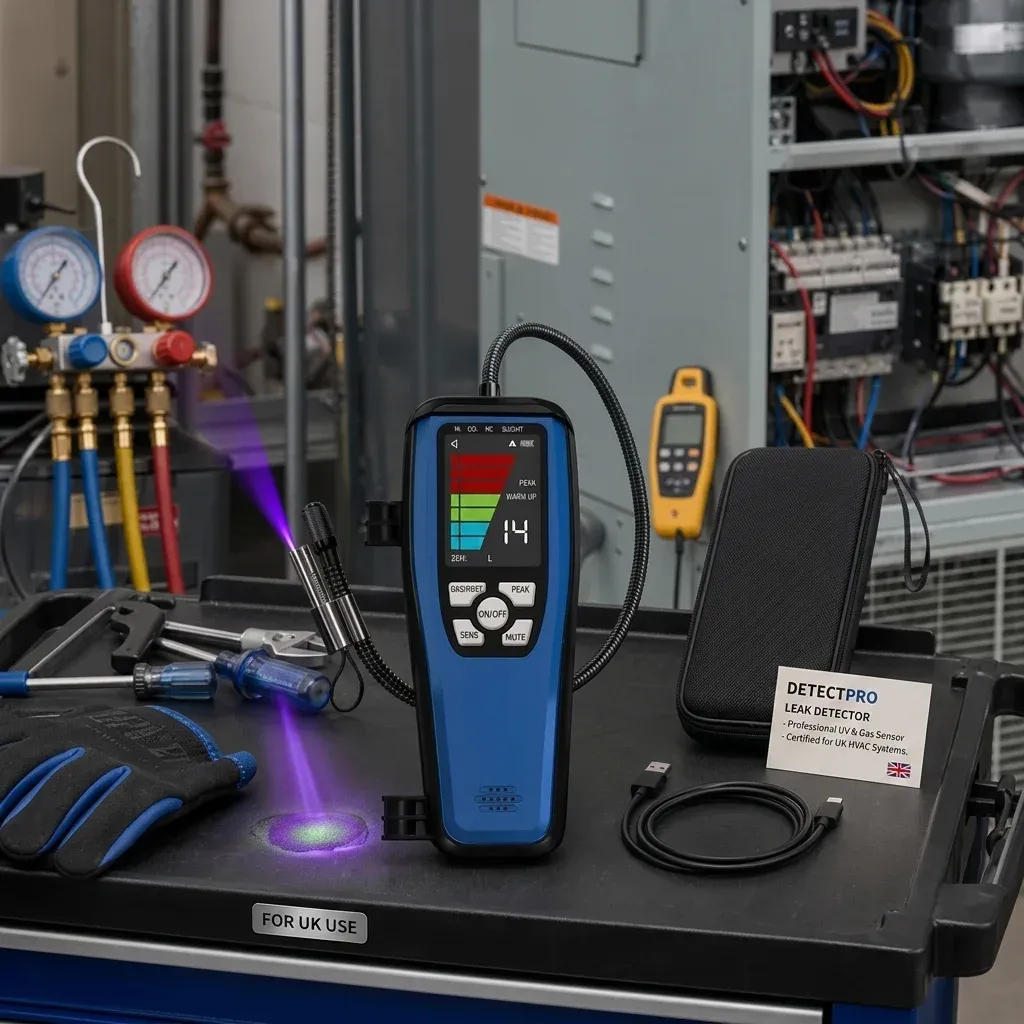
Short answer: an air conditioning leak detector is an electronic tool that sniffs out escaping refrigerant so you can pinpoint a leak on an AC system quickly, instead of guessing from pressures alone. For a busy UK engineer the features that actually matter on site are dependable sensitivity, a flexible probe, clear audible and on-screen alerts, and a rechargeable battery that lasts a full day of call-outs.
If your old detector has just died on the last job of the day and the diary is full for the rest of the week, you do not have time for a tool that needs a bag of AA batteries or fades after an hour. This guide covers what a good air conditioning leak detector has to do, and how to choose one you can rely on from the first call-out to the last.
What should a UK engineer look for in an air conditioning leak detector?
- Dependable sensitivity to common AC refrigerants (R32, R410A and R454B) so a small leak is not missed.
- A rechargeable battery that lasts a full working day, so one charge covers a diary full of call-outs.
- A flexible probe plus a clear screen and audible alert, so you can work from a condenser in full sun to a dim loft without juggling a torch.
- UK stock and next-day dispatch, so a failed detector can be replaced before tomorrow's jobs.
How does an air conditioning leak detector work?
Most professional units are electronic "sniffers": an internal pump draws air across a sensor, and when refrigerant is present the sensor reacts, sounds an alarm and shows a reading. The most common sensor for daily AC work is the heated diode, which reacts to the fluorine and chlorine in halogenated refrigerants and is known for being sensitive without being fooled by background smells and cleaners. For the full comparison of sensor types, see our halogen leak detector guide.
On an AC system you are usually checking flare joints, the service valves on the outdoor unit, brazed joints and the indoor coil. An electronic detector lets you sweep a wide area fast; many engineers then confirm the exact spot with bubble spray, which is the combination UK F-Gas guidance recommends.
Why battery life and portability matter on call-outs
In a heatwave, when every AC unit in the area seems to fail at once and the diary is already full, the practical things win. A detector that runs on disposable AA cells always seems to go flat mid-job, and keeping a bag of spares in the van is a false economy. A rechargeable tool that lasts a full day means you charge it overnight and forget about it.
The other daily reality is light. You go from a condenser baking in full sun to a dim loft or a cramped cupboard within the same hour, so a built-in light and a screen you can read in both places save you fishing for a torch with your hands already full.
What about replacing a detector in a hurry?
When a detector dies and you cannot borrow one, "next-day dispatch" only helps if the stock is real and the courier reaches your postcode. Buying from a UK warehouse with genuine stock and free UK delivery is the difference between getting back to a full diary tomorrow and cancelling on customers. It is worth checking the delivery estimate for your area before you order.
Air conditioning refrigerants: what your detector must cover
UK AC and heat pump work increasingly means A2L refrigerants such as R32 and R454B, alongside older R410A. A2L gases are mildly flammable, so the detector you use should be an intrinsically safe type rather than a spark-based one. Heated diode detectors are a sensible choice here because they do not rely on a high-voltage spark. If most of your work is split systems and heat pumps, check the gas list before buying. For the hands-on method of tracing a leak on a heat pump, our refrigerant gas sniffer guide walks through it, and for how the sensing works from first principles, our HVAC leak detector guide explains it.
Choosing the Aprvtio ALD-200 for air conditioning leak detection
The Aprvtio ALD-200 is built for exactly this kind of day. It uses heated diode sensing, supports R32, R454B, R410A and R134a, and pairs a 2.8-inch display with an audible alarm plus integrated UV and LED lights, so you can work in the dark without a separate torch. A 3000 mAh rechargeable battery is rated for up to around 10 hours, so one charge is designed to cover a full day of call-outs, and a 16-inch flexible probe reaches awkward joints. It is £128.99 inc. VAT (£107.49 ex. VAT), ships from UK stock with next-day dispatch and free UK delivery, and comes with a 12-month UK warranty and 30-day returns. It is rated 4.7 out of 5 from 285 reviews. The heated diode tip has a stated active life of roughly 100 to 200 hours, and replacement sensors are available.
Get a rechargeable detector that lasts a full day of call-outs
View the Aprvtio ALD-200 — £128.99Frequently asked questions
What is the best type of air conditioning leak detector for UK engineers?
For daily AC and heat pump work, a heated diode electronic detector is a strong all-rounder: it is sensitive to common refrigerants such as R32, R410A and R454B, it is not spark-based so it suits mildly flammable A2L gases, and it is not prone to false alarms. Look for a flexible probe, a clear screen and a rechargeable battery.
Can one air conditioning leak detector cover R32, R410A and R454B?
Yes, provided the manufacturer lists those gases. The Aprvtio ALD-200 supports R32, R454B, R410A and R134a, which covers most UK split-system, heat pump and older AC work from a single tool. Always check the stated gas list before buying.
How long should the battery last for a full day of call-outs?
Choose a rechargeable detector rather than one that runs on disposable AA cells that go flat mid-job. The Aprvtio ALD-200 has a 3000 mAh battery rated for up to around 10 hours, so a single overnight charge is designed to cover a full diary of jobs.
Do I still need bubble spray if I have an electronic detector?
It helps. UK F-Gas guidance suggests using an electronic detector to sweep a wide area quickly, then confirming the exact leak point with bubble solution. Using the two techniques together gives you speed and certainty before you recover and repair.
Ready to upgrade your diagnostics with Aprvtio?
Shop Detectors — £128.99