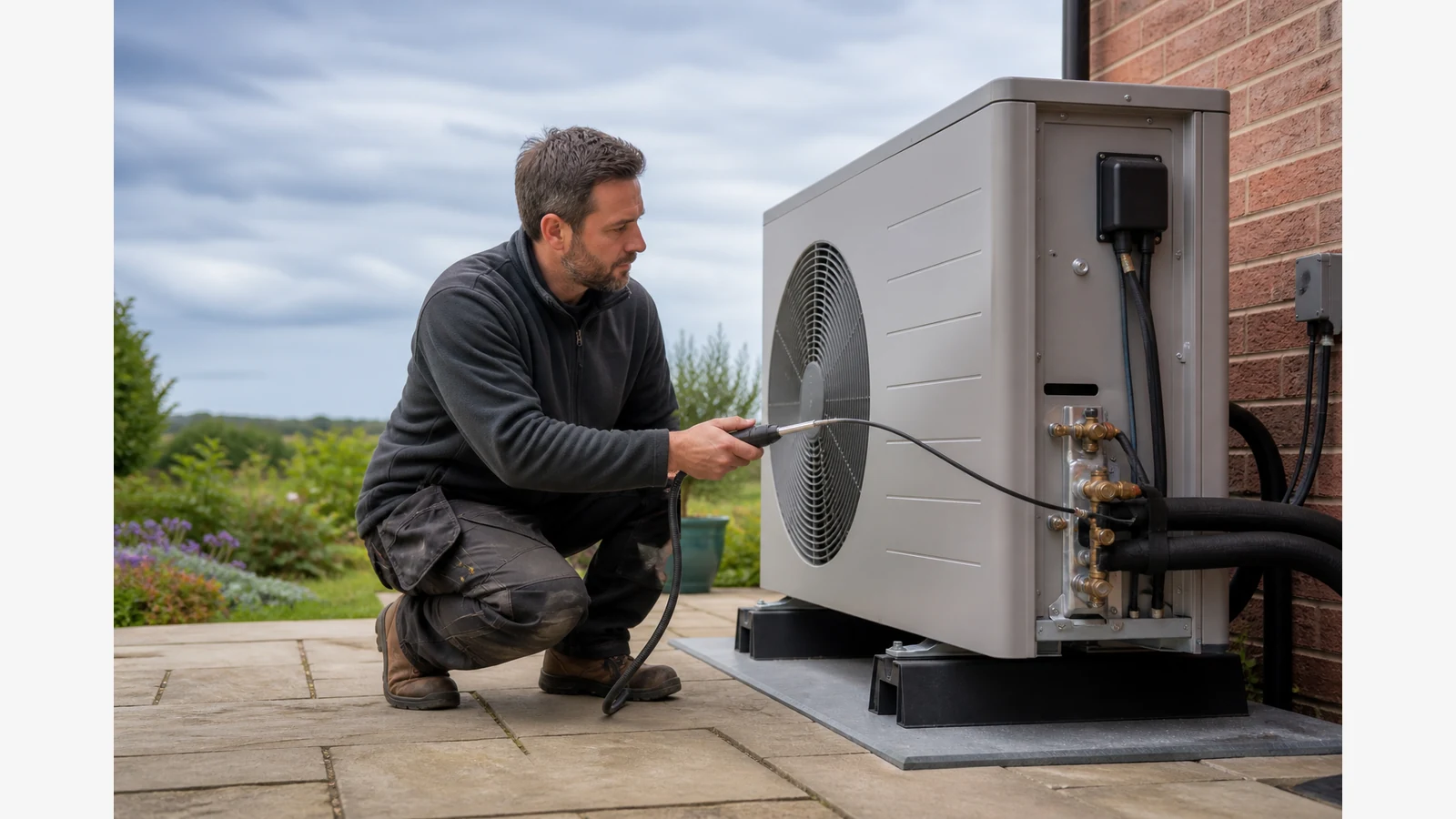
Heat Pump Outdoor Unit Leak Scan Checklist Uk
Before you recharge an R32 heat-pump outdoor unit after a failed pressure recheck or a heating-season efficiency complaint, follow a fixed scan order: visual oil clues, clean-air warm-up, slow probe scan of valves, flares and coils, then bubble spray on the joints you already suspect. A sniffer narrows the search; it does not replace F-Gas competence or manufacturer commissioning rules.
Why outdoor units need a checklist
UK call-outs often start with “no obvious oil stains” yet the system still fails tightness or feels down on performance. Outdoor casings hide service valves, flare nuts, Schrader cores and coil return bends where a short hard probe cannot stay steady. Trade guidance lists electronic detectors together with OFN pressure testing and leak-detection spray as complementary methods — see SRW’s HVAC and heat-pump leak testing overview.
Outdoor-unit scan sequence
- Isolate and look first. Note oil staining, missing valve caps, damaged insulation and recent work marks before the instrument comes out.
- Warm up in clean air. Power on away from the unit so the tip is not sitting in a refrigerant plume while it settles.
- Choose sensitivity deliberately. Start higher to find a zone, then reduce once the signal rises so you can pin a joint rather than chase background.
- Scan slowly. Move the tip at roughly one to two inches per second along service valves, flare nuts, Schrader cores, then coil return bends the housing still allows you to reach.
- Confirm suspects with spray. Bubble solution on the narrowed joints before you declare a repair plan.
- Escalate when needed. If the sniffer cannot isolate a path, move to OFN prove-up, vacuum integrity checks and full F-gas records rather than guessing a recharge.
Where a long flexible probe and a display help
A long flexible probe helps you reach valve packs and coil edges inside a tight outdoor housing without claiming miracle micro-leak rates. A concentration-style display helps you compare signal strength as you re-approach the same joint — useful when a beeper-only tool leaves you circling. Keep published sensitivity wording in mind when comparing tools; treat marketing g/year figures as vendor claims until you see accredited test evidence. For how standards language frames those numbers, read EN 14624 sensitivity explained for UK buyers.
After you find a leak
GOV.UK expects prompt repair and a repeat leak test within a month to confirm the repair held — see GOV.UK guidance on checking F-gas equipment for leaks. Put that recheck on the job card; do not treat a single sniffer pass as the end of the ticket. Detail the diary habit in F-gas post-repair leak verification.
Who should not rely on the sniffer alone
Do not use this checklist as a substitute for F-Gas qualification, manufacturer commissioning procedures, or nitrogen prove-up when the electronic path stays ambiguous. If you are still deciding whether you need a portable locating tool or a fixed plant-room monitor, start with portable sniffer versus fixed monitor.
When you want a mid-price heated-diode handheld with a long probe for R32 / R454B outdoor work, compare the published field features on the Aprvtio advanced leak detector product page.