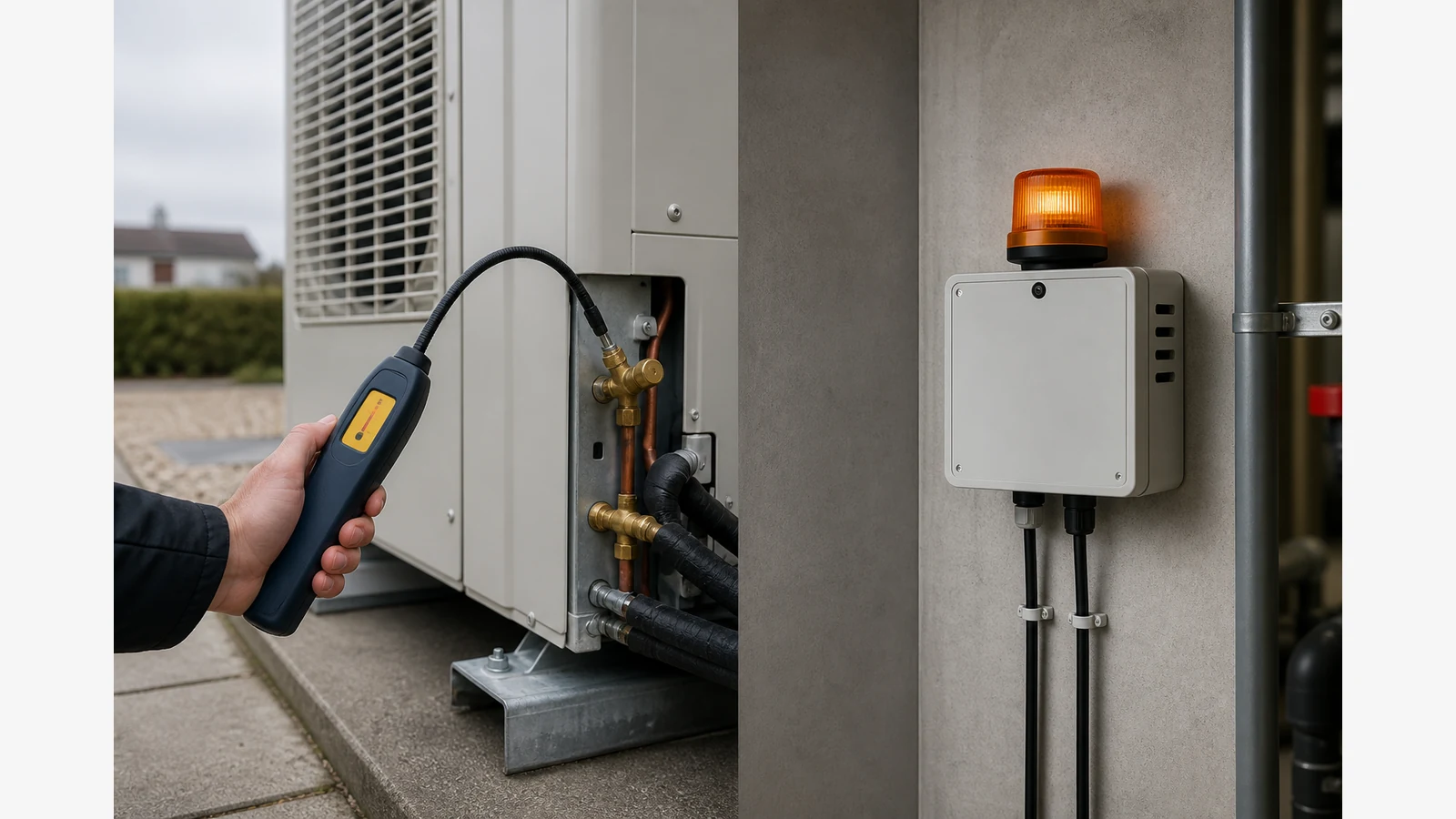
Portable Refrigerant Sniffer Vs Fixed Monitor Uk
A portable refrigerant sniffer and a fixed plant-room monitor are not interchangeable. The handheld tool is for locating joints, valves and coils on a service call; a fixed monitor is a life-safety or room-protection device under plant design rules such as EN 378 practical-limit concepts. Confusing the two jobs is a common UK plant-room mistake.
Two different jobs
Trade explainers draw a clear line between refrigerant monitors used for people protection (often discussed alongside roughly 30-second response expectations in EN 378 contexts) and high-sensitivity leak-detection systems used for emissions or maintenance work. See the ACR Journal feature on monitoring versus leak detection confusion.
FETA’s A2L / EN 378 guidance likewise treats detector roles for safety measures and trigger-concentration concepts as separate from portable service tools. Read the FETA A2L EN 378 technical guide (PDF) when you are specifying room protection rather than packing a van kit.
What UK F-gas duties actually ask for
Operators of stationary refrigeration, air-conditioning and heat pumps must check for F-gas leaks on a CO2e-based schedule, and fit automatic leak detection above published charge thresholds. That is operator duty language on GOV.UK F-gas leak checking guidance — not a claim that a van sniffer equals a fixed automatic system.
Always confirm current thresholds for the plant you look after. This article is practical orientation, not legal advice.
Decision table: handheld locate vs fixed monitor
| Situation | Prefer | Why |
|---|---|---|
| Call-out to find which flare, Schrader or coil bend is weeping | Portable locating sniffer | You need probe reach and local signal, not a room alarm |
| Occupied plant room with A2L charge near practical limits | Fixed / aspirated monitor per design | Life-safety and ventilation interlocks are room-scale duties |
| Periodic F-gas leak checks on accessible joints | Handheld electronic method within a wider procedure | Direct locating supports scheduled checks; it does not replace records |
| High CO2e charge requiring automatic detection | Automatic leak detection as operator guidance requires | GOV.UK separates this from handheld service tools |
What a heated-diode handheld cannot replace
A heated-diode portable detector can help you narrow a joint set, show relative signal strength, and work with a flexible probe in tight housings. It does not meet fixed-monitor response-time expectations, does not prove EN 378 room-alarm compliance, and should never be marketed as a wall-mounted plant-room monitor substitute.
For outdoor heat-pump joint order on the day, use a disciplined scan checklist such as our heat pump outdoor unit leak scan checklist. After a repair, build the one-month recheck into the ticket using F-gas post-repair leak verification.
Match tool class to the job
Before you buy a second detector “because the plant room felt risky”, ask: am I locating a service leak, or am I specifying continuous room protection? Service locate and life-safety monitoring stay on different purchase paths. If A2L van work versus A3 hazardous contexts is the real fork, read when ATEX is needed versus an A2L portable sniffer.