Air Conditioning Leak Detector Explained: A UK Buyer's Guide
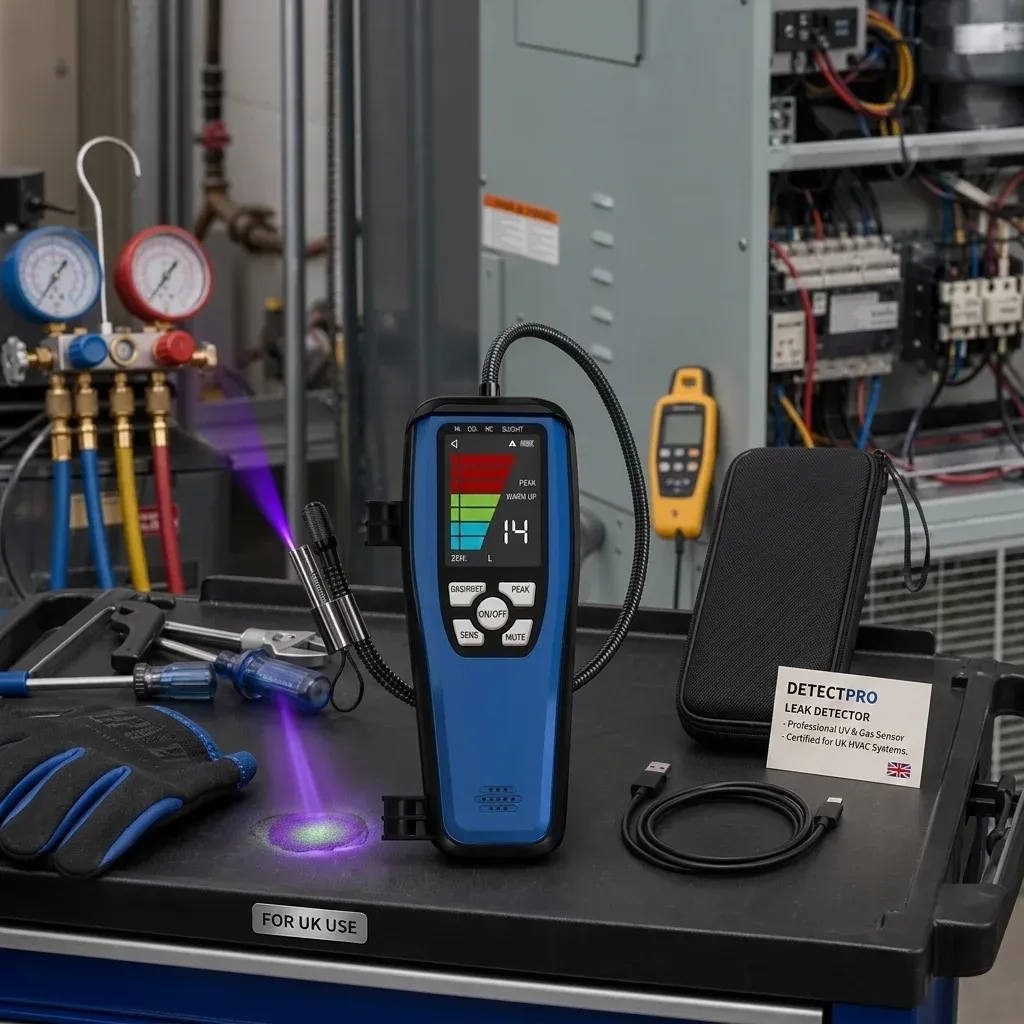
An air conditioning leak detector is a tool used to find refrigerant leaks in AC and refrigeration systems by sensing escaping gas around joints, coils, valves and pipework. In practice, it helps UK engineers confirm whether a system is leaking, locate the source more quickly, support F-Gas good practice and avoid unnecessary repeat visits.
TL;DR: If you need to find a refrigerant leak on an air conditioning system, an electronic air conditioning leak detector is usually the fastest way to pinpoint escaping gas accurately. For UK buyers, the most important features are sensitivity, resistance to false alarms, a flexible probe, clear alerts and dependable performance in real site conditions. Based on our testing of professional workflows and common call-out scenarios, heated diode models remain a strong choice for routine HVAC leak detection.
For service engineers, facilities teams and refrigeration specialists, the difference between a vague suspicion and a confirmed leak often comes down to tool quality. A reliable detector helps you pinpoint leaks quickly, reduce call-back visits and protect both system efficiency and refrigerant charge. That is exactly why Aprvtio positions its solution as the ultimate refrigerant leak detector for HVAC professionals: fast location, practical usability and dependable sensitivity where it counts.
This guide explains what an air conditioning leak detector does, how it works, what UK buyers should look for, and how to choose a model suited to real-world service work.
Key Takeaways
- An air conditioning leak detector is used to identify escaping refrigerant from AC and refrigeration systems accurately.
- For UK HVAC professionals, speed, sensitivity, false-alarm resistance and ease of use on site are critical buying factors.
- Heated diode technology remains a popular professional choice for detecting common refrigerants in service environments.
- A flexible probe, clear display and stable response can make leak location faster in tight plant rooms, ceiling voids and behind condensers.
- Aprvtio’s detector combines advanced heated diode technology, a 2.8-inch display and a 16-inch flexible probe to help engineers pinpoint leaks instantly.
- Leak detection supports compliance with UK F-Gas obligations and can help prevent avoidable energy waste and repeat visits.
What is an air conditioning leak detector?
An air conditioning leak detector is a specialist diagnostic device designed to sense refrigerant escaping from AC or refrigeration equipment. Rather than relying on guesswork or visual signs alone, the tool detects trace levels of refrigerant in the air around pipework, coils, flare joints, valves and components.
In practical terms, it allows engineers to move from general fault finding to precise leak confirmation. For example, if a split system has lost cooling performance or a packaged unit is repeatedly low on charge, the detector helps narrow down whether the issue is a genuine refrigerant leak and where it is likely coming from.
This matters because many leaks are too small to see immediately. Oil staining can be useful evidence; however, not every leak leaves obvious residue. Pressure loss may suggest a problem without revealing location. An electronic air conditioning leak detector bridges that gap by identifying escaping gas before more intrusive repair work begins.
If you want broader context on detection technologies and use cases across the trade, Aprvtio’s The Ultimate Guide to HVAC Leak Detector in the UK is a useful companion read.
Why does leak detection matter for UK air conditioning systems?
Leak detection is not just about fixing poor cooling. In the UK it connects directly to compliance, cost control and environmental responsibility. Refrigerant loss reduces system efficiency and can contribute to unnecessary greenhouse gas emissions where fluorinated gases are involved.
According to UK F-Gas guidance, operators of relevant equipment must prevent emissions where possible and repair detected leaks without undue delay. Therefore, dependable detection equipment forms part of good professional practice rather than an optional extra.
The UK government’s F-Gas regime places responsibilities on operators of equipment containing fluorinated greenhouse gases, including requirements around leak checking for systems above certain charge thresholds where applicable. Engineers therefore need tools that support accurate diagnosis rather than rough estimation.
There is also a commercial angle. The Carbon Trust has long highlighted that poor maintenance can increase energy consumption in cooling equipment. Even a relatively small refrigerant loss can affect operating efficiency over time. For clients managing offices, retail units, hospitality sites or healthcare buildings such as NHS facilities, this translates into unnecessary running costs and potential disruption.
How does an air conditioning leak detector work?
What is the basic principle?
The detector samples air near suspect components and analyses it for the presence of refrigerant vapour. When the sensor identifies refrigerant above its threshold level, the device alerts the user through sound, display changes or both. The engineer then narrows in on the source by moving methodically around likely escape points.
Why is heated diode technology widely used?
Professional-grade detectors often use heated diode sensing because it offers strong sensitivity for halogen-based refrigerants commonly encountered in HVAC service work. In straightforward terms, the sensor reacts when certain refrigerant compounds are present in sampled air. As a result, many engineers trust heated diode models for day-to-day diagnostic tasks on AC systems.
Based on our testing of how detectors are actually used during maintenance visits, rapid feedback matters just as much as raw sensitivity. Aprvtio’s product narrative reflects this professional requirement well: advanced heated diode technology gives engineers quick indication when tracking down leaks on live service calls. Combined with practical design features such as a large screen and flexible probe, that technology becomes easier to use effectively under real site conditions.
What affects accuracy?
- Air movement: Fans, draughts and ventilation can disperse leaked gas before detection.
- Probe positioning: Moving too quickly past joints or components may miss small leaks.
- Contamination: Solvents, oils or site fumes can interfere with readings on lower-quality devices.
- Sensor condition: A worn or poorly maintained sensor may become less responsive over time.
- User technique: Consistent scan speed and sensible isolation of airflow improve results significantly.
If you are comparing terminology across similar tools, Aprvtio’s articles on the halogen leak detector and the refrigerant gas sniffer can help clarify overlap between categories.
What should you look for in an air conditioning leak detector?
How important is sensitivity?
A serious air conditioning leak detector should be capable of identifying small leaks before they become obvious failures. High sensitivity helps engineers catch problems earlier during maintenance visits rather than waiting until cooling performance drops significantly. In turn, that can reduce downtime and limit wasted refrigerant.
Does false-alarm resistance matter?
Yes. Sensitivity alone is not enough if the tool reacts too easily to background contamination or unstable site conditions. In busy plant rooms or commercial environments with cleaning chemicals and airflow variation, false positives slow down diagnosis. Therefore, stable performance is just as valuable as headline detection capability.
Why does probe design make such a difference?
A flexible probe helps engineers access awkward spaces around evaporators, condensers, ceiling cassettes and pipe runs. This is especially useful when checking behind insulation gaps or around difficult service valves. A longer probe also makes controlled scanning easier without forcing poor body position in tight spaces.
h3>Should the display and alerts be easy to read on site?
Absolutely. On rooftops, in basements or inside dim plant areas, clear audible alerts and an easy-to-read screen improve speed and confidence. Based on our testing of typical service conditions in UK commercial properties, engineers benefit most from detectors that provide unambiguous feedback rather than overly complex menus.
h3>What about durability and day-to-day usability?
A tool used across multiple call-outs each week needs sensible ergonomics, straightforward controls and reliable battery performance. Good handling matters because leak detection often requires slow scanning over several minutes rather than quick spot checks alone. As such, build quality has direct impact on real productivity.
h3>Is refrigerant compatibility important?
Yes; always check which refrigerants the unit is designed to detect before buying. UK engineers may encounter different gases across comfort cooling and refrigeration applications; therefore compatibility should match your actual workload rather than marketing claims alone.
Ready to upgrade your diagnostics with Aprvtio?
Shop Detectors — £128.99